

Progress and Patterns
Struggling with What it Means to Be Human

“Is there anything of which one can say, ‘Look! This is something new’? It was here already, long ago; it was here before our time.”
~ Ecclesiastes 1:10 ~
I hate hiccups. They heave and cleave to my chest, jolting my insides with a force unmatched. No cough, however deep or productive, matches the vomit-like surge of each hiccup, ripping invisible rocks across the esophagus time and again. Yes, a sneeze rivals the full-body seizure of a hiccup, yet there’s an incarceration in a fit of hiccups that arrests your attention, disrupts your conversation, and ends not with a tingling delight but with a fear that what unfolded may erupt again if you breath too quickly. Or too slow. Or even at all.
I’m sitting in a Panera in downtown Boston at the intersection of Stuart and Tremont reading Plato’s Symposium. My seat is perched by a corner of windows. People pass by trying to navigate the befuddling traffic patterns, their steps hiccupping between the sidewalk and the intersection. The crosswalks are illuminated with a red hand that persists even as cars idle in all direction. A man pulls his wife deeper into the intersection looking in every direction except the way the cars start to come. She pulls him back. He’s frustrated, that is, until the bus careens just feet in front of him.
Moments pass. A new set of pedestrians approach. And variations of the same pattern unfold.
Behind me, a large group of young adults cackle, barely able to fit in the four tables they’ve awkwardly pieced together. Those at the end lean in trying to be part of the fun, only to lean back in frustration, unable to garner much attention at the table. The ebb and the flow of the conversation ignores the predictable pattern of “lean-in-hopeful; lean-out-frustrated; rinse-and-repeat.”
The woman to my left leans forward into her phone with piercing intensity as two faces stare back from her screen, “Yes, that’s what I…oh sorry, Larry. You go!” she shrieks. Uproarious laughter erupts from the young adults behind her. She glares in their direction. Back to the screen. Unable to hold her own attention. Even after she aggressively gets up from her chair, whose metal loudly screeches across the tile floor, she relocates to a table across the room in search of more privacy, but the pattern simply unfolds anew.
I feel like I’ve seen this before. Not a de ja vu or anything, but the pattern. The push and pull for attention, for space, for silence, for belonging, for isolation, for safety, for progress. A repeating hiccup in society as long as human memory can recollect.
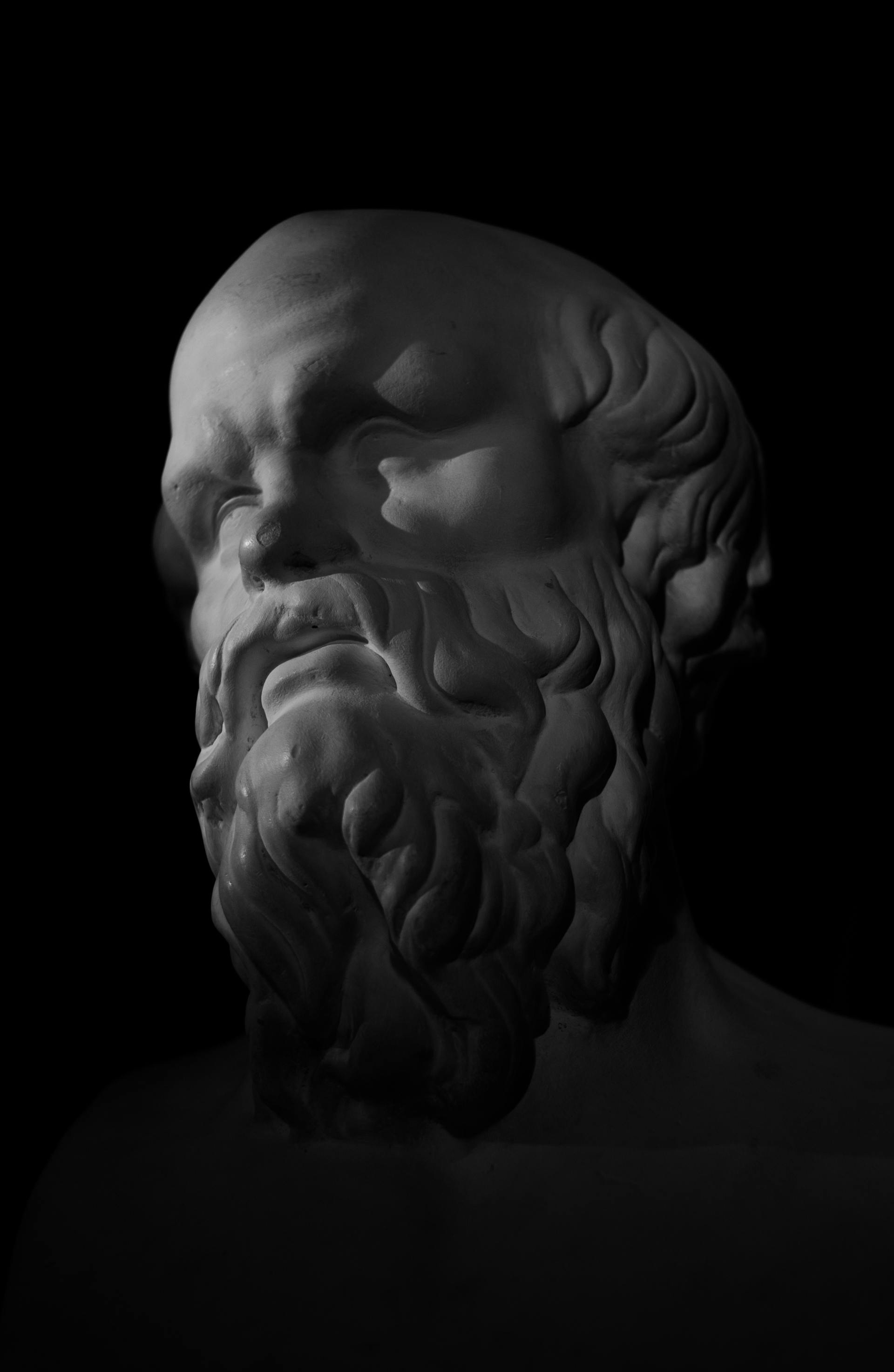
In Plato’s Symposium, a group has gathered. Food served. Some late. Some only partially invited. Some clubbing for positions of prominence. Others unsure if they ought to even be in the room at all. Even though Plato’s scene takes place over four hundred years before Christ, I find it oddly familiar, as if it could happen in this Panera right now.
The guests take their seats. Dinner is served. A topic surfaces: what is love?
Like a diamond, the guests of the symposium take their turn exposing different rays of light to this rare gem, exploring what is acceptable in love, what is typical, what is noble, what is effective. Each guest trying to contribute to this collective ode to that which Parmenides envisioned as birthed “before all other gods”—Love.1
After Phaedrus and Pausanias offer their eloquence in honor of Love, Aristophanes is next in line. An award-winning playwright flush with satirical wit, everyone swells with anticipation for his soliloquy to honor Love. However, Aristophanes is suddenly stricken “with a hiccup, which prevented him from speaking” (Sym. 185 D). Consumed by this unruly bodily disruptor, he asks the doctor next to him to either “stop my hiccup or to speak in my stead until I can stop it.” The physician kindly offers to do both, also advising the hiccup-riddled Aristophanes:
“During my speech, if on your holding your breath a good while the hiccup chooses to stop, well and good; otherwise you must gargle with some water. If, however, it is a very stubborn one, take something that will tickle your nostrils, and sneeze: do this once or twice, and though it be of the stubbornest, it will stop.” (Plato, Sym. 185 E)
I set my book down a bit surprised. “I’ve not heard all those remedies,” I thought. Typically, I confront my hiccups with a concentrated stare. I find an un-busy surface on a table or a wall, I soften my gaze, and with concentrated effort, I move into a relaxed state. If interrupted in any way, be it from within or someone beside, the hiccups will lurch victoriously. Yet if successful, after thirty-seconds or so, the pattern is broken. My breathing rhythm returns. My attention restores. And the hiccups don’t encore.
As ridiculous as it feels to sit here and muse on hiccups, a deeper insight calls to me: even over 2,500 years ago, humans were pretty much the same.
Sure, in the name of progress, a god we honor even more than love itself, we presume much has changed. We cling to our technological advances as evidence of chronological superiority, of a modern sophistication that dwarfs the archaic, and yet, we still pattern our politics on the Roman Republic, our mathematics on Pythagorean theorems, and the arts on Greek tragedies and comedies. We can’t replicate the durability of the Coliseum’s concrete; we can’t fathom the construction of the pyramids; we can’t mirror the religious and electromagnetic precision of Stone Henge. Even still, we walk across our concrete jungles with an arrogance of progress, as if Louis Vuitton outperforms the Laodicean purple or Radio City Music Hall outshines the Ephesian Amphitheater.
Sure, we’ve harnessed electricity with unparalleled precision, but have we cured the cancer of lust? Okay, we’ve employed science to explore the oceans below and the celestial bodies that dance in the sky, but have we bested the bully within each of us that tells us we’re all alone, that no one cares, and that we’re left out because we’re unloved?
Reading history, philosophical or otherwise, reveals the haunting truth: the soul of the human is just as belabored today as it was when Socrates stood in Athens and Christ was crucified on Calvary.
I was thirty-one years old when I finished my Ph.D., missing my goal by one year. I remember the day I received my diploma. I tore open the insulated cardboard adorned with the iconic Edinburgh logo to find a single piece of thick A4 paper with my government name written in cursive font. My wife sat next to me and placed her head on my shoulder as we both stared intently, softening our gaze a bit as we silently reflected on the sacrifice it took to bring us to this moment.
Softly, she asked, “What’re you thinking?”
I paused uncomfortably. Unsure of what to say. Or maybe how to say it.
I began to speak unsure of what words would come, “I’m thinking,” I hiccupped, “I’m thinking, ‘I thought this was going to feel different.’”
We all try to outrun our pain. Especially wounds from our past. Sure, it looks different for each person, but the patterns are the same. We cling to whatever we think will give us rest or some semblance of healing—money, power, sex, drugs, alcohol, parties—but in the end, the pain remains and threatens to devour more with each passing day.
And I’m no different. It’s just my pattern was more socially acceptable than others.
I was addicted to work. To accomplishing more and more with increasing rapidity. And with each degree came accolades and words of affirmation spurring me ever further into my brokenness in the name of progress. Since all of it was related to the Bible, it was easy to overlook how fractured and fragile I really was.
Only later, through much therapy and even more prayer, I realized that deep down, without knowing it, I thought the Ph.D. would heal me. Would mend what was broken in me. And when it didn’t, I was confused. Devastated, really.
In the pages of Plato and even in the present, I look around and find the same sickness in others. The same “progress” shrouding patterns of brokenness like garments of skin constructed to cover our shameful nakedness.
Leaders today still sell their soul for power, believing it can satisfy all that longs within. Celebrities today still believe that accolades and attention will make them whole, will heal what is broken within. Children still deceive, adults still drown in greed, and humans still long to belong.
I wish it were different. Especially for Christians. Especially for those of us who believe that, in Jesus Christ, Love became flesh and dwelled among us. That truth incarnated in Bethlehem, curing the evils within.
But in the church and in the hearts of Christ-followers, patterns emerge that look embarrassingly similar to Phaedrus, Pausanius, and even Aristophanes. Hiccups of the soul that, regardless of every trick we’ve employed, simply won’t leave. Won’t relent. Consistently remind us that after all our efforts there’s still more to overcome.
Plato, Symposium 178 B, referencing Parmenides, fr. 132. Cf. Aristotle, Met. i.4, 984 b.